
The Question Beaconsfield Families Are Quietly Asking
There is a question that Beaconsfield parents rarely ask out loud but think about often, particularly in the months before their child starts at Beaconsfield Primary or Christ the King: Did those years at childcare actually make a difference?
It is an honest question. The early years feel significant — the first words, the first friendships, the outdoor environment, the educators who seemed to know your child so completely. But when a child crosses the threshold of a primary school classroom for the first time, the childcare years can seem like they belong to a different world. What did those years actually produce that the school years will draw on?
Australian research now has a specific, measurable answer to this question. Not a general one about “the importance of early years” — a precise one about what quality early childhood education specifically predicts in children at primary school age. And the findings are more concrete, and more consequential, than most Beaconsfield families realise.
What Australian Research Now Shows — 2024 and 2025
The most significant recent Australian study on this question comes from the Australian Education Research Organisation (AERO), in partnership with the Queensland Brain Institute at the University of Queensland. Published in September 2024, their technical report linked two major Australian datasets — the Person Level Integrated Data Asset and the landmark E4Kids longitudinal study (2,494 children, five years of tracking) — to examine precisely how ECEC quality relates to child developmental outcomes in Australia.
 AERO / E4Kids Technical Report — September 2024 (Australian Education Research Organisation)
This finding matters directly for Beaconsfield families. Meeting the NQS — the standard that the majority of Australian childcare centres achieve — is not, according to this research, the threshold at which quality produces meaningfully better developmental outcomes for children. The threshold is Exceeding. The research specifically concludes that Exceeding NQS is where quality early childhood education begins to make a measurable difference to children’s developmental trajectories into primary school and beyond.
Little Learners holds a KindiCare rating of 8.8 — one of the highest in Perth’s southern suburbs — reflecting the programme quality, educator-child interaction richness, and outdoor environment that are the specific drivers of child outcomes identified in the AERO research. This is not incidental. It is the direct result of twelve years of deliberate investment in exactly the quality levers the research identifies as consequential.
- 2,494 = Children tracked in the E4Kids Australian longitudinal study — the most extensive ECEC research ever conducted in Australia
- Exceeding = NQS rating threshold at which quality ECEC reduces developmental vulnerability at school entry, per AERO/E4Kids (2024)
- $15B = Annual Australian government investment in ECEC — reflecting the policy consensus that early years quality has long-term national consequences
The OECD Says It Too — Specifically About Australia
In January 2025, the OECD published a dedicated Country Note on Australia as part of its global series on reducing inequalities through early childhood education and care. The conclusion was unambiguous: the early years set the foundations for children’s development and learning trajectories in life. Early inequalities can put children on divergent paths, but ECEC policies can level opportunities from the start, with lasting economic and social benefits.
The OECD’s analysis of Australia specifically identified that early inequalities in development — the gaps that show up in the Australian Early Development Census when children enter primary school — are substantially shaped by the quality of early childhood experiences in the 0–5 years. Children whose early years include high-quality ECEC consistently arrive at primary school less developmentally vulnerable, and that advantage persists and compounds through the school years.
For Beaconsfield families, the OECD finding translates directly: the years a child spends at an early learning centre near Beaconsfield are not a holding pattern until school begins. They are the period when the developmental architecture that school will draw on for the next thirteen years is being built — and the quality of the early learning environment determines the quality of that architecture.
What Nature-Based Early Learning Specifically Produces — New Australian Evidence
A November 2025 study published in Education Sciences (MDPI) — conducted at an Australian metropolitan school implementing a nature play programme alongside its existing play-based learning curriculum — provides some of the most direct recent evidence on what nature-based early learning specifically produces in children as they move through primary school.
The study used the GINGER model — a child-centred, nature-inclusive framework examining holistic development across wellbeing, engagement, sense of belonging, and nature pedagogies — and found that children who had experienced nature-based learning in the early years demonstrated distinctly different engagement patterns in primary school: stronger environmental curiosity, more confident physical engagement with complex outdoor spaces, greater capacity for sustained attention in outdoor learning contexts, and what the researchers described as a “nature identity” — a felt sense of belonging in natural environments — that non-nature-experienced peers consistently lacked.
Critically, the study also noted that primary schools — even well-intentioned ones — are increasingly described as sites of “systemic play deprivation,” where curriculum pressures reduce the very experiences that children from nature-based early learning backgrounds are most equipped to benefit from. The implication for Beaconsfield families is direct: the nature-based foundation their child builds at our early learning centre near Beaconsfield is not simply preparation for a nature-rich primary school experience. It is a developmental reserve the child carries with them regardless of what primary school provides — a way of attending, exploring and relating to the world that does not disappear when the outdoor environment does.
 Australian Research — Nature Play in Early Years of Formal Schooling (November 2025)
What a Little Learners Childhood Specifically Builds — and Why It Carries Forward
The research now available — Australian, recent, and specific — allows us to be concrete about what the years a Beaconsfield child spends at our early learning centre actually produce. Not in the language of developmental philosophy, but in the language of outcomes that Beaconsfield Primary teachers and parents can observe and measure.
 Executive Function That Compounds
The self-regulation, working memory and cognitive flexibility built through years of complex outdoor play, learning circles and real-world challenge do not plateau at school entry. They compound. Children who arrive at Beaconsfield Primary with strong executive function learn more effectively from the first day — because they can attend, persist, manage frustration and shift strategies. The AERO/E4Kids research identifies educator-child interaction quality — exactly what our long-serving educators provide — as the primary mechanism through which this capacity develops.
 Language That Opens Doors
Vocabulary at age five is one of the strongest predictors of reading comprehension at age ten, academic achievement at fifteen, and outcomes beyond. The language environment at our early learning centre near Beaconsfield — rich, responsive, outdoor, curiosity-driven, screen-free — produces vocabulary breadth and language confidence that teachers describe as immediately visible in how children engage with text, instruction and discussion. It is not accelerated learning. It is the natural consequence of years of being taken seriously as a conversational partner.
 Environmental Identity
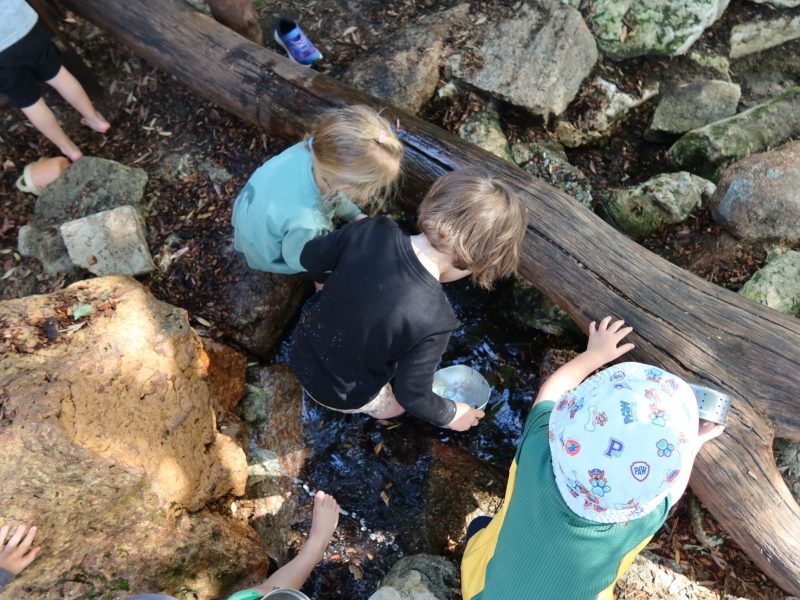
The November 2025 MDPI study specifically identifies “nature identity” — a felt sense of belonging in natural environments — as something that nature-based early learning produces and that conventional settings cannot replicate later. Children who have spent their early years in creek beds, gardens and natural outdoor environments arrive at primary school with a relationship to the natural world that shapes how they attend, what they notice, and what they care about. The Beaconsfield community’s strong environmental values are reflected back in children who have lived them, not just heard about them.
 Social Competence That Holds Under Pressure
The peer negotiation that happens daily in a rich outdoor early learning environment — over resources, space, roles and rules — builds the social brain through hundreds of real interactions with real stakes. Children who have spent years managing these interactions arrive at primary school socially capable in a way that is distinct from social competence developed in more managed, indoor settings. They know how to repair conflict, read social cues, advocate for themselves and make room for others. Beaconsfield Primary teachers see this difference — and they see it compound over the primary school years.
 Physical Capability and Confidence
Children who have spent years navigating creek beds, balance logs, real tools and varied natural terrain arrive at primary school physically confident in the specific way that matters most in a school setting: they can sit for sustained periods, they have the core strength and fine motor control that handwriting requires, and they have the physical confidence to engage fully with the playground social world that is so important in the early primary years. Physical literacy, like language, compounds — and its foundations are built in the early years or not at all.
 Intrinsic Curiosity That Survives Formal Schooling
Perhaps the most important and least measurable outcome of a quality nature-based early learning experience is what might be called the disposition to wonder — a child’s relationship to not-knowing and to finding out. Children who have spent their early years following genuine curiosity in a genuinely rich environment arrive at primary school wanting to learn, not merely complying with the requirement to do so. This disposition is, by every measure in the Australian research, the most powerful academic protective factor available — and it is built, or not built, in the years before school begins.
What Beaconsfield Primary and Christ the King Teachers See
 The Schools Beaconsfield Children Attend After Little Learners
The research does not suggest that every child from a high-quality early learning background will outperform every child who attended a lower-quality setting. Individual variation is real and significant. What it shows is that, on average and at population scale, the quality of a child’s early learning experience is one of the most powerful predictors of how they fare when formal education begins — and that the threshold for this effect is Exceeding, not merely Meeting, the National Quality Standard.
For Beaconsfield families who are choosing where their child will spend the years from six weeks to six years, this finding is not abstract. It is the most practical and consequential piece of information available for the decision they are making. It means that the difference between a good enough early learning centre and a genuinely excellent one — in terms of what the child carries forward to Beaconsfield Primary and beyond — is measurable, significant, and visible in outcomes that persist for years.
The Decade That Built This
Little Learners opened in White Gum Valley in 2014 — three minutes from Beaconsfield via York Street. For twelve years, the children who have attended have brought home the vocabulary of creek beds and native animals, the confidence of a child who has used a real saw and made something real, the physical ease of a body that has climbed rocks and balanced on logs and run barefoot across woodchip ground. They have eaten food grown in the garden and cooked over sustainably sourced wood. They have cared for chickens and worm farms and living things that depended on them. They have spent years in conversation with long-serving educators who knew their names, their interests and their particular way of being in the world.
The Australian research now available tells us, with more precision than was previously possible, what that decade of experience produces. It produces developmental outcomes that are measurably better at the Exceeding quality threshold than at lower quality levels. It produces a nature identity that school cannot replicate. It produces executive function, language, physical capability and social competence that compound through the primary school years. And it produces something harder to measure but consistently reported by parents whose children have been through it: a child who is genuinely, durably, unperformatively curious about the world — and who will carry that quality into every classroom they ever sit in.
- Beaconsfield
- White Gum Valley
- South Fremantle
- Hilton
- Hamilton Hill
- O’Connor
- Beaconsfield Primary
- Christ the King
- Winterfold Primary
Frequently Asked Questions
What does the AERO/E4Kids research actually show about quality early learning?
The Australian Education Research Organisation’s September 2024 technical report — linking the E4Kids longitudinal study (2,494 Australian children) with population data — found that quality of early childhood education and care directly predicts children’s developmental outcomes into the school years. Critically, it found that Exceeding the National Quality Standard is the threshold at which quality begins to reduce developmental vulnerability at school entry, emphasising educator-child interaction quality as the primary mechanism. The full report is available at the AERO website. For Beaconsfield families, this means the distinction between a good enough centre and a genuinely excellent one is not philosophical — it is measurable in outcomes that persist into primary school.
How does nature-based early learning specifically affect children at primary school age?
A November 2025 Australian study (MDPI Education Sciences) using the GINGER model found that children with nature-based early learning backgrounds demonstrated stronger environmental identity, richer holistic development, and greater capacity for the exploratory, curious engagement with the world that nature experiences specifically produce. This nature identity — a felt sense of belonging and confidence in natural environments — is something that cannot be acquired later in the same way it is built in the early years. The study also noted that primary schools increasingly provide insufficient nature-based experience, making the early learning foundation more rather than less consequential.
How far is Little Learners from Beaconsfield and what are the local primary schools?
Little Learners is approximately 3 minutes from Beaconsfield via York Street. Our address is 242 South St, White Gum Valley WA 6162. Phone: (08) 9335 6941. Open Monday to Friday, 6:30am–5:30pm. Children from our early learning centre near Beaconsfield proceed to Beaconsfield Primary School, Christ the King Catholic Primary School and Winterfold Primary School. Our all-inclusive daily fee of $140 covers all meals, enrichment activities, wildlife incursions and Kinderloop. We are fully CCS approved.
What is Little Learners’ quality rating?
Little Learners holds a KindiCare rating of 8.8 — one of the highest ratings among early learning centres in Perth’s southern suburbs. The AERO/E4Kids research identifies Exceeding the NQS as the quality threshold at which early childhood education begins to produce meaningfully better long-term outcomes for children. Our rating reflects the programme quality, educator-child interaction richness, outdoor environment design and educator continuity that the research identifies as the specific drivers of those outcomes. If you’d like to discuss our programme in detail, we encourage you to visit and ask us directly about what we do and why.
What does your programme specifically do that produces these long-term outcomes?
The AERO/E4Kids research identifies educator-child interaction quality as the primary mechanism through which quality ECEC produces better outcomes. Our long-serving educators — many of whom have been with Little Learners for years — know each child deeply and provide the kind of responsive, sustained, curious engagement that drives language, executive function and social-emotional development. Our 650m² outdoor environment — creek bed, balance logs, native trees, mud kitchen, gardens, real tools — provides the physical complexity and challenge that builds the capabilities children carry forward. Our screen-free, all-inclusive, nature-first programme integrates all of this into a daily experience that is, by any measure, Exceeding. You can read more about our outdoor programme in our post on outdoor play and nature learning for Beaconsfield families.
Come and See What the Research Describes
The outcomes Australian research identifies in children from quality early learning settings are visible, every day, in our outdoor environment and our educators’ interactions with children. Book a tour of our early learning centre near Beaconsfield and see what twelve years of Exceeding looks like in practice. We’re 3 minutes from Beaconsfield via York Street.